

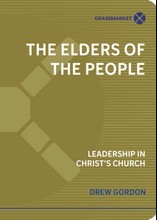
Drew Gordon, The Elders of the People: Leadership in Christ’s Church.
Pittsburgh: Crown and Covenant Publications, 2025. Pp. 156. $10.00, paper.
“The institution of the office of ruling elder is divine; it is not an ordinance of man but of God. The Lord Jesus Christ, upon whose shoulders the government is, and who is faithful in all his house, hath in his eternal wisdom thought fit to appoint such an officer in his house, for the right and orderly governing thereof.”
— James Guthrie, A Treatise of Ruling Elders and Deacons, p. 24
Eldership is, needless to say, one of the fundamental systems the Lord has instituted for his church. If you have been in the Reformed Presbyterian Church for any length of time, you have no doubt heard many times about the importance of this office.
Gordon begins by laying out the doctrine of eldership in his earlier chapters. In chapter two, he explains the role and function of elders, strengthening his observations by clarifying what leadership really means. He identifies its authoritative, servant, and shepherding character. Chapter five then takes up the biblical qualifications for an elder by looking closely at 1 Timothy 3 and Titus 1.
From chapter six onward, Gordon moves into more practical and down-to-earth aspects of serving as an elder. In chapter six, he writes about election and ordination, and even includes his own personal experience of being chosen as a ruling elder in his congregation. Chapter seven describes his work as a member of session, how he approaches session meetings, and how he serves as an elder both in and outside those meetings, as well as in the wider courts of the church. In chapter eight, he touches on the connection between an elder and his family, again sharing from his own experience as a husband whose wife supported him in this calling.
This book is, of course, a very good read for anyone wanting to learn what Scripture teaches about elders. But what makes it especially valuable is the way Drew shares his personal experiences of becoming and serving as a ruling elder. His stories help us see how eldership actually works in the life of a local congregation. For example, in chapter six he tells a moving story of how he was discouraged after not being elected as an elder in his first or second nomination, and how other elders and his pastor came alongside him with wise counsel.
It is not only through doctrine, but also by encountering men who actually live out the calling of faithful eldership, that our understanding of this office deepens. Through that, a healthy admiration for the role naturally grows, because we see a real and relatable example before us. When I lived in Northern Ireland, this was something I noticed and appreciated: many congregations had a natural culture of valuing and honouring their elders, a culture passed down from generation to generation.
By contrast, in mission churches or newer congregations, such a tradition is not always present. There may not yet be clear examples of what eldership looks like in practice, and members can find it difficult to picture what an elder really is. That is why I hope this book will allow Drew Gordon to serve as a living and practical example of a ruling elder. For that reason, I gladly recommend this book to everyone—especially to those in younger fields of mission, or in places like here in Japan where visible models of eldership are not always available.
Yusuke Hirata
Pastor of Kasumigaoka RPC in Kobe, Japan
